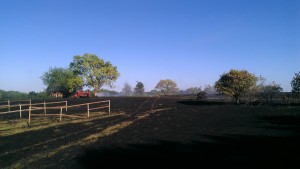
High winds and low relative humidity will increase the risk of uncontrolled wildfire throughout the afternoon. Please refrain from outdoor burning until conditions improve.
One Vehicle Accident Closes I-35
- January 27th, 2012

A one vehicle accident occurred on Southbound I-35 at the 36.6 mile marker on Thursday, January 27 2012. A commercial truck pulling a large trailer mounted generator left the roadway and overturned. The generator became detached from the pulling vehicle, continued down the median, and caught fire after coming to rest on it’s side. The generator included a 400 gallon fuel tank with approximately 250 gallons of fuel on board. The fire quickly consumed the generator, and spread to engulf a portion of the highway median. A small amount of diesel fuel spilled from the generator after the fire was extinguished. A remediation team was dispatched from the private company who own’s the vehicle to clean up the spill. No significant environmental impact is expected. The driver of the vehicle sustained minor injuries. The vehicle pulling the trailer and the trailer are both total losses.
The Clinton County Sheriff’s Dept, Missouri State Highway Patrol, Lathrop Fire Protection District, Holt Fire Protection District, Clinton County Emergency Management, Tri-County Ambulance, MODOT, and Sam’s Tow of Lathrop responded to the accident.
High winds contributed to spread of the fire after the accident. An investigation into the cause of the accident is being conducted by the Missouri State Highway Patrol.
Power out in Plattsburg and Lathrop
- December 21st, 2011
Power out in Plattsburg and Lathrop. We have been told 3pm target for restoration. Cause unknown.
Winter weather advisory has been extended
- December 19th, 2011
Winter weather advisory has been extended to Clinton County. Travel with care and out of necessity.
Roads in Northern Clinton County Ice / Slush Covered
- December 19th, 2011
Roads in Northern Clinton County ice/slush covered. Travel with care.
First Winter Storm of the Season
- December 19th, 2011
First winter storm of the season will begin affecting Clinton County. Sleet changing over to snow tonight with… http://t.co/V2IINAVf
Veterans Day
- November 11th, 2011
Thank You to all of the men and women who have, are currently, or will in the future serve in our nation’s armed forces. We are forever endebted for you service.
National Emergency Alert System Test
- November 8th, 2011
The First Nationwide Emergency Alert System Test will take place November 9, 2011 at 1:00PM CST
The first nationwide test of the Emergency Alert System will incorporate all commercial broadcast entities, but will not utilize NWS weather radio stations. The test is expected to take 30-60 seconds to complete. This is the first time that a nationwide activation of the Emergency Alert System has been attempted. Broadcasters are required to conduct weekly and monthly tests of the system.
The message that viewers see during the test may differ from weekly or monthly required tests. The reason for this is that in order for a nationwide alert to take place, a live EAN or Emergency Action Notification will be issued. This is the same activation message that would be issued in an actual emergency.
This test will likely be the first of annual national tests. These tests are being conducted with the goal of improving emergency information communication abilities of federal, state, and local emergency managers. The Emergency Alert System, nor it predecessor, the Emergency Broadcast System have ever been activated on a national scale. This test will allow a critical proof-of-concept confirmation that in dire emergency situations, the President of the United States will be able to convey important information to the entire US public.
Further information on the Emergency Alert System, and the tests being conducted can be found here: FEMA IPAWS EAS Nationwide Test
Magnitude 5.6 Earthquake in Central Oklahoma Felt in Clinton County
- November 5th, 2011
The United State Geological Survey recorded a 5.6 magnitude earthquake located roughly 21 miles NNE of Shawnee, OK at 10:53 PM on November 5, 2011. The epicenter of the quake is located roughly 320 miles from the City of Cameron. Reports of isolated damage in areas surrounding the epicenter have been reported. The quake was felt throughout the midwest.
If you felt the quake, make a report with the USGS at: http://t.co/wMGW1uw7
These reports allow the USGS to better map how earthquake energy travels.
While earthquakes in non-seismic zones are rare, they do happen.
If an Earthquake Occurs:
Drop, cover and Hold On. Minimize your movements to a few steps to a nearby safe place and if you are indoors, stay there until the shaking has stopped and you are sure exiting is safe.
If Indoors
- DROP to the ground; take COVER by getting under a sturdy table or other piece of furniture; and HOLD ON until the shaking stops. If there isn’t a table or desk near you, cover your face and head with your arms and crouch in an inside corner of the building.
- Stay away from glass, windows, outside doors and walls, and anything that could fall, such as lighting fixtures or furniture.
- Stay in bed if you are there when the earthquake strikes. Hold on and protect your head with a pillow, unless you are under a heavy light fixture that could fall. In that case, move to the nearest safe place.
- Do not use a doorway except if you know it is a strongly supported, load-bearing doorway and it is close to you. Many inside doorways are lightly constructed and do not offer protection..
- Stay inside until the shaking stops and it is safe to go outside. Do not exit a building during the shaking. Research has shown that most injuries occur when people inside buildings attempt to move to a different location inside the building or try to leave.
- DO NOT use the elevators.
- Be aware that the electricity may go out or the sprinkler systems or fire alarms may turn on.
If Outdoors
- Stay there.
- Move away from buildings, streetlights, and utility wires.
- Once in the open, stay there until the shaking stops. The greatest danger exists directly outside buildings, at exits and alongside exterior walls. Many of the 120 fatalities from the 1933 Long Beach earthquake occurred when people ran outside of buildings only to be killed by falling debris from collapsing walls. Ground movement during an earthquake is seldom the direct cause of death or injury. Most earthquake-related casualties result from collapsing walls, flying glass, and falling objects.
If in a Moving Vehicle
- Stop as quickly as safety permits and stay in the vehicle. Avoid stopping near or under buildings, trees, overpasses, and utility wires.
- Proceed cautiously once the earthquake has stopped. Avoid roads, bridges, or ramps that might have been damaged by the earthquake.
If Trapped Under Debris
- Do not light a match.
- Do not move about or kick up dust.
- Cover your mouth with a handkerchief or clothing.
- Tap on a pipe or wall so rescuers can locate you. Use a whistle if one is available. Shout only as a last resort. Shouting can cause you to inhale dangerous amounts of dust.
Winter Weather Preparedness
- November 4th, 2011
Winter weather in Northwest Missouri can range from very mild to very severe. It is important to prepare for winter weather prior to the begin of cold weather, and important to check your supplies often during the season to be sure they are still adequate for further severe weather events.
Before Winter Storms and Extreme Cold
Add the following supplies to your disaster supplies kit:
- Rock salt to melt ice on walkways
- Sand to improve traction
- Snow shovels and other snow removal equipment.
Prepare your home and family
- Prepare for possible isolation in your home by having sufficient heating fuel; regular fuel sources may be cut off. For example, store a good supply of dry, seasoned wood for your fireplace or wood-burning stove.
- Winterize your home to extend the life of your fuel supply by insulating walls and attics, caulking and weather-stripping doors and windows, and installing storm windows or covering windows with plastic.
- Winterize your house, barn, shed or any other structure that may provide shelter for your family, neighbors, livestock or equipment. Clear rain gutters; repair roof leaks and cut away tree branches that could fall on a house or other structure during a storm.
- Insulate pipes with insulation or newspapers and plastic and allow faucets to drip a little during cold weather to avoid freezing.
- Keep fire extinguishers on hand, and make sure everyone in your house knows how to use them. House fires pose an additional risk, as more people turn to alternate heating sources without taking the necessary safety precautions.
- Learn how to shut off water valves (in case a pipe bursts).
- Know ahead of time what you should do to help elderly or disabled friends, neighbors or employees.
- Never run a generator in your garage during a power outage. CO (Carbon Monoxide) can build to dangerous levels inside your home causing severe injury or death.
Prepare your car
Check or have a mechanic check the following items on your car:
- Antifreeze levels - ensure they are sufficient to avoid freezing.
- Battery and ignition system - should be in top condition and battery terminals should be clean.
- Brakes - check for wear and fluid levels.
- Exhaust system - check for leaks and crimped pipes andrepair or replace as necessary. Carbon monoxide is deadly and usually gives no warning.
- Fuel and air filters - replace and keep water out of the system by using additives and maintaining a full tank of gas.
- Heater and defroster - ensure they work properly.
- Lights and flashing hazard lights - check for serviceability.
- Oil - check for level and weight. Heavier oils congeal more at low temperatures and do not lubricate as well.
- Thermostat - ensure it works properly.
- Windshield wiper equipment - repair any problems and maintain proper washer fluid level.
- Install good winter tires. Make sure the tires have adequate tread. All-weather radials are usually adequate for most winter conditions. However, some jurisdictions require that to drive on their roads, vehicles must be equipped with chains or snow tires with studs.
- Maintain at least a half tank of gas during the winter season.
Place a winter emergency kit in each car that includes:
- Shovel
- Windshield scraper and small broom
- Flashlight
- Battery powered radio
- Extra batteries
- Water
- Snack food
- Matches
- Extra hats, socks and mittens
- First aid kit with pocket knife
- Necessary medications
- Blanket(s)
- Tow chain or rope
- Road salt and sand
- Booster cables
Dress for the Weather
- Wear several layers of loose fitting, lightweight, warm clothing rather than one layer of heavy clothing. The outer garments should be tightly woven and water repellent.
- Wear mittens, which are warmer than gloves.
- Wear a hat.
- Cover your mouth with a scarf to protect your lungs.
Maintain Good Situational Awareness
- Pay attention to the weather forecast during the winter months, and make travel and family plans accordingly
- Buy a weather radio, and program it to alert for your county. Keep fresh batteries in the radio so it works during power outages
- During winter weather, travel only if necessary.
- When traveling, let someone know when you will leave, when you will arrive, and what route you plan on taking.